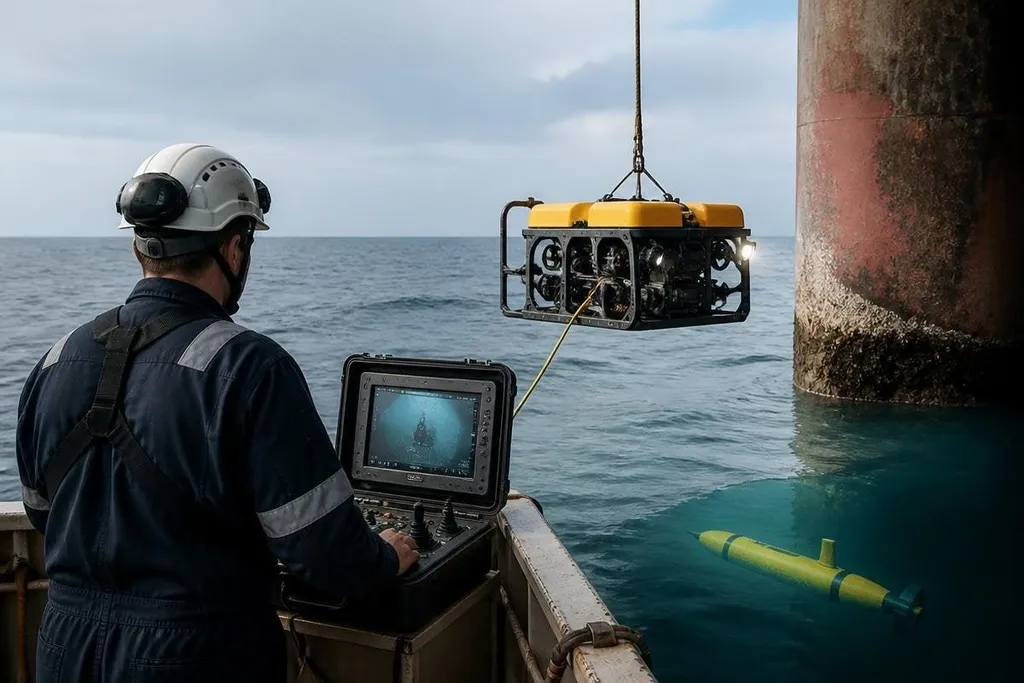
A remotely operated vehicle can inspect a ship hull while its operator stays on deck. An autonomous underwater vehicle can map the seabed without a cable, but it must work with less help once it leaves the surface.
- ROVs use a tether for power, control, and live video.
- AUVs carry batteries, sensors, and navigation systems inside the vehicle.
- Pressure, poor visibility, and weak communications remain hard limits.
Where underwater robots help
The clearest benefit is keeping people out of dangerous water. A robot can inspect an offshore structure, search a wreck, or check a pipe after an accident without sending a diver into the first pass.
An ROV, or remotely operated vehicle, stays connected to a support vessel through a tether. The cable carries control signals and video, and larger systems can send power down to the vehicle. Operators can guide a camera, sonar unit, or manipulator arm while watching the feed from the surface.
That setup suits work that needs a human decision. An operator can move closer to a damaged valve, change the camera angle, or use an arm to collect an object. The tether also gives the crew a direct route to the vehicle if the task changes.
AUVs take a different route. An autonomous underwater vehicle follows a planned route with its own battery and sensors. Sonar helps it map the seafloor when light cannot reach the target, while inertial sensors and other navigation tools help it estimate its position.
The result is useful for surveys that cover a wide area. An AUV can gather data below ice, across a harbor, or along a cable route without keeping a pilot in control every second. It can also work where a long tether would drag across the seabed or catch on structures.
An underwater survey can miss a fault when the robot loses its position or its camera view turns murky. Check the named machine, mission, test date, and reported result in Robot 24 before the article turns to the risks that remain.
The risks that remain
Removing a diver does not remove danger from the job. A vehicle can lose power, damage its tether, or become trapped beneath a structure. A recovery team may then need to send people into the water to retrieve equipment worth a large amount of money.
Water also blocks radio signals, so most underwater robots cannot rely on the same wireless links used by machines on land. An ROV needs its tether for a steady connection. An AUV may store data until it returns, which means a crew might not learn about a problem during the mission.
Pressure adds another failure point. Seals, housings, connectors, and cameras must keep water away from electronics at the working depth. A small leak can end a mission and damage parts that are hard to reach at sea.
Navigation has limits too. GPS signals do not travel through deep water, and a vehicle can drift when currents change. Sonar can find objects, but the image may be harder to read than a camera view. A planned route still needs checks against depth, terrain, traffic, and battery use.
People still carry the risk
Operators need training in the vehicle, the sensors, the water conditions, and the task itself. A camera feed can show a pipe, but it cannot decide whether a crack is safe to ignore. That decision needs inspection rules and a person who understands the cost of a wrong call.
Data can create another problem. A survey may produce large sonar maps and hours of video, yet a damaged cable can remain easy to miss. Teams need a clear way to mark findings, review the data, and send a diver or repair crew only when the evidence supports it.
I'd choose an underwater robot first for inspection or mapping, then plan human access for the parts the robot cannot verify.
A practical choice guide
Before choosing a system, check these points:
- Task: Decide whether you need live control, a planned survey, or physical work with a manipulator arm.
- Depth: Match the vehicle and its pressure housing to the full working depth, not the average depth.
- Connection: Check how the system handles lost control, damaged tether, or delayed data.
- Visibility: Pair cameras with sonar when mud, darkness, or distance can hide the target.
- Recovery: Set a plan for a stalled vehicle, low battery, trapped tether, or failed return route.
- Evidence: Define how the crew will record, review, and confirm each finding.
The right choice depends on the job’s depth, distance, and need for live decisions. An ROV gives people more control but keeps a support vessel and tether in the plan; an AUV covers routes with less direct control but leaves more decisions until recovery. The next step is a small survey that tests the vehicle, data quality, and recovery plan before anyone depends on it for a high-cost inspection.